This week’s intriguing Inheritance Book choice is from romantic suspense writer Gail Barrett.
Hi Gail, welcome to Inheritance Books. Tell us a bit about yourself.

I guess you could say I’m a language aficionado. I love everything to do with language — speaking, reading, translating, writing. I’ve taught Spanish and English as a Foreign Language for years. I’m also the author of thirteen romantic suspense novels which have won various awards, including the National Readers’ Choice Award, the Book Buyers’ Best Award, and the Holt Medallion.
Thirteen sounds like a portentous number. Let’s hope it wins lots of awards. Which book have you inherited from the generation above? Why is it special?
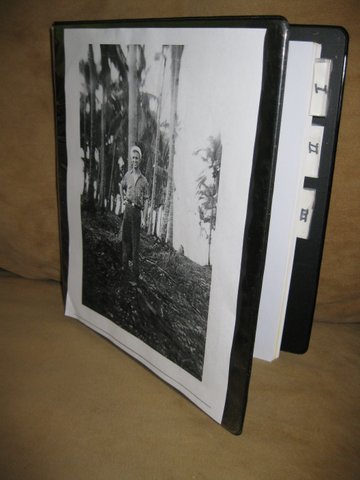
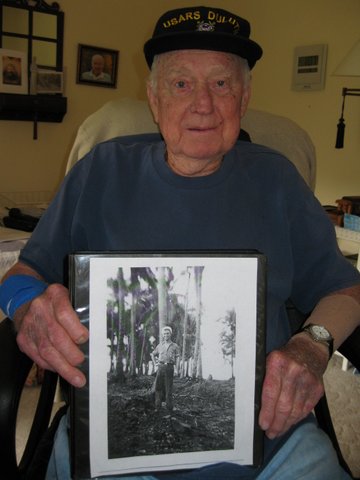
The book I inherited didn’t start out as an actual book. Some years ago, my father, Joe Archer, began writing a memoir about his time in World War II. At first he just jotted down a few paragraphs about the highlights, but then he really started getting into it, revising the story, providing background information and photos until he had compiled a book.
What’s interesting about my father is that he is a quick-witted, funny man with a great, self-deprecating sense of humor. He was born in 1920 and grew up in a small farming town in Michigan during the Great Depression. Like most people of that generation, he works hard, is frugal, and never puts on airs. What I like most about his memoirs is how perfectly they reflect his personality.
Here are a few of the highlights:

At the start of the war, he was too young to enlist without his mother’s permission, and since his older brothers were already fighting, she refused to let him go. He went to work in a local factory instead, where he accidentally chopped off the tips of two of his fingers — and was fired for carelessness! The accident also disqualified him from military service because it (supposedly) affected his ability to shoot. Still determined to do his part, he kept his hand in his pocket when he interviewed with the Coast Guard, and they allowed him to enlist. The guy who took his fingerprints during processing apparently didn’t care, so he was in!
He was anxious to fight the enemy, but first got sent to boot camp in Buffalo, New York. After boot camp he was stationed on a coal burning ore carrier out of Cleveland, assigned to protect the “Iron ore pipeline” in the Great Lakes — not exactly how he’d envisioned fighting the war. Ironically, they made him an armed guard, missing fingers or not.
After an endless stint on the coal burner he went to radio school with the hopes of being transferred…and was assigned right back to an ice breaker on the Great Lakes. He was convinced that he’d never see the war.
But then his luck changed. He was finally transferred to an old, retrofitted Army supply ship in California manned by Coast Guard personnel. Their ship was in such bad condition and so slow that they couldn’t keep up with their convoy, so they had to cross the Pacific Ocean to New Guinea alone. They suffered a bad moment when they spotted a submarine periscope, but apparently the Japanese decided not to waste a torpedo on them. If our own military didn’t care enough about them to provide an escort, they weren’t worth shooting at. (In an ironic twist, after the war our government gave the ship to Japan to use for a fish canning factory, but they decided it wasn’t seaworthy and scrapped it.)
His ship arrived in Hollandia Harbor, which was filled with Macarthur’s invasion force, preparing to take the Philippines. He went ashore for mail, and while he was on the pier, Macarthur walked by with the president of the Philippines, nearly knocking him down. My father was so surprised that he forgot to salute.
After surviving Leyte Gulf, he continued ferrying supplies around the South China Sea. One day they got a message no one could decipher. The message kept repeating, but they had no idea what it meant. Turned out it was a warning to take shelter immediately from the coming typhoon… Caught at sea, his ship hit the sea floor twice during the terrible storm. Luckily, they survived.
At the end of the war, my father found out that their ship’s radio transmitter didn’t work. Although they could receive messages, the antenna had been tied off during some repairs, keeping them from sending one out. If they had needed it, he couldn’t have radioed for help.
Throughout the book, my father’s wry comments not only capture the essence of who he is, but provide some levity to what was surely a horrific time. And to add to the quirkiness, he typed the entire book in capital letters since that is what radiomen were taught to do.
Which book would you leave to generations below? Why?
So that’s the book I’ve inherited, and it’s the same one I intend to hand down. Certainly there are books that are better written or have more literary importance. But my father’s book is still inspiring. It is a great reminder that there are all types of stories — big, small, earth-sweeping or local — and that all of us, no matter who we are, have one that is worthy to tell.
That sounds like a very special book. I love that it’s all in caps too. It’s surprising how someone’s writing can give you an insight into their personality. Thank you Gail (and Joe)for sharing your lovely book with us. Please drop by again soon.

Gail’s latest book Fatal Exposure is out now. You can find out more about her on her website (www.gailbarrett.com) or on Facebook.
Addendum (29 July 2013)- Gail’s Dad, Joe Archer, dropped by in the comments section to give a brief summary of his career in the Navy. His comment is reproduced below (in caps, naturally!)
FROM: JOE Archer
GAIL HAS ENCOURAGED ME TO WRITE SOMETHING FOR THE “BLOG”. THRU A LACK OF UNDERSTANDING OF THE BLOG NEEDS I WILL INSTEAD GIVE A BRIEF SUMMARY OF MY FOUR YEARS IN WWII. HOPE YOU FIND IT INTERESTING AS IT IS MORE TYPICAL THAN YOU MIGHT EXPECT.
I WAS ON SEVEN SHIPS DUIRING THE WAR: 3 MERCHANT TYPES – 1 CG – 2 US ARMY & 1 US NAVY. I HAD 6 MONTHS OF SHORE DUTY (RADIO SCHOOL) & THE REST WAS “SEA TIME”…THERE WERE TWO PERIODS (ONE FOR SIX MONTHS & THE OTHER 18 MONTHS) WERE THERE WAS NO R & R , – CONTACT WITH CIVILIAN LIFE – LITTLE OR NO MAIL – ETC –ETC
MY TIME IN THE SOUTH PACIFIC WAS ONE OF CONSTANT APPREHENSION . WE TRAVELED OUT OF CONVOY (ONE EXCEPTION) ON SLOW SHIPS THAT WERE LIGHTLY ARMED. BECAUSE OF THEIR SPEED THEY WERE CONSIDERED EXPENDABLE & THE US NAVY DID NOT PROTECT US.. MY SHIPS PARTICIPATION INCLUDED COMBAT OPERATIONS AT : HOLLANDIA – LEYTE – MINDORO – LINGAYEN GULF = MAN ILA = CEBU =SOUTHERN LUZON – PALAWAN – & AN ISLAND OFF NORTH BORNEO… WE WERE LUCKY THRU ALL OF THAT WE WERE LIGHTLY TOUCHED ( JUST ONE WOUNDED) & MINOR SHIP DAMAGE. WE DID SHOOT DOWN TWO LOW FLYING JAPANESE PLANES..AND SEE OTHER SHIPS DAMAGED & SUNK
AFTER THE WAR (AS WITH MOST VETS) I HAVE LIVED WITH PHYSICAL & MENTAL PROBLEMS ( HEARING PROBLEMS, 40% COMPREHENSION LOSS – A PORTION OF ONE LUNG DAMAGE CAUSED BY JUNGLE ROT – CLOSTRAPHOBIA – A PIECE OF METAL IN ONE HAND THAT TOOK 25 YEARS TO MIGRATE SO THAT IT COULD BE REMOVED.)
I WAS PROUD & ANXIOUS TO BE A PART OF THE MILITARY & STILL AM. NO REGRETS – AS A VET I HAVE NEVER & WILL NEVER LOOK TO THE US GOVERNMENT FOR HELP OF ANY KIND .. I AM RESPONSIBLE FOR WHATEVER HAPPENSTO ME…..
 Jeevani Charika and Rhoda Baxter